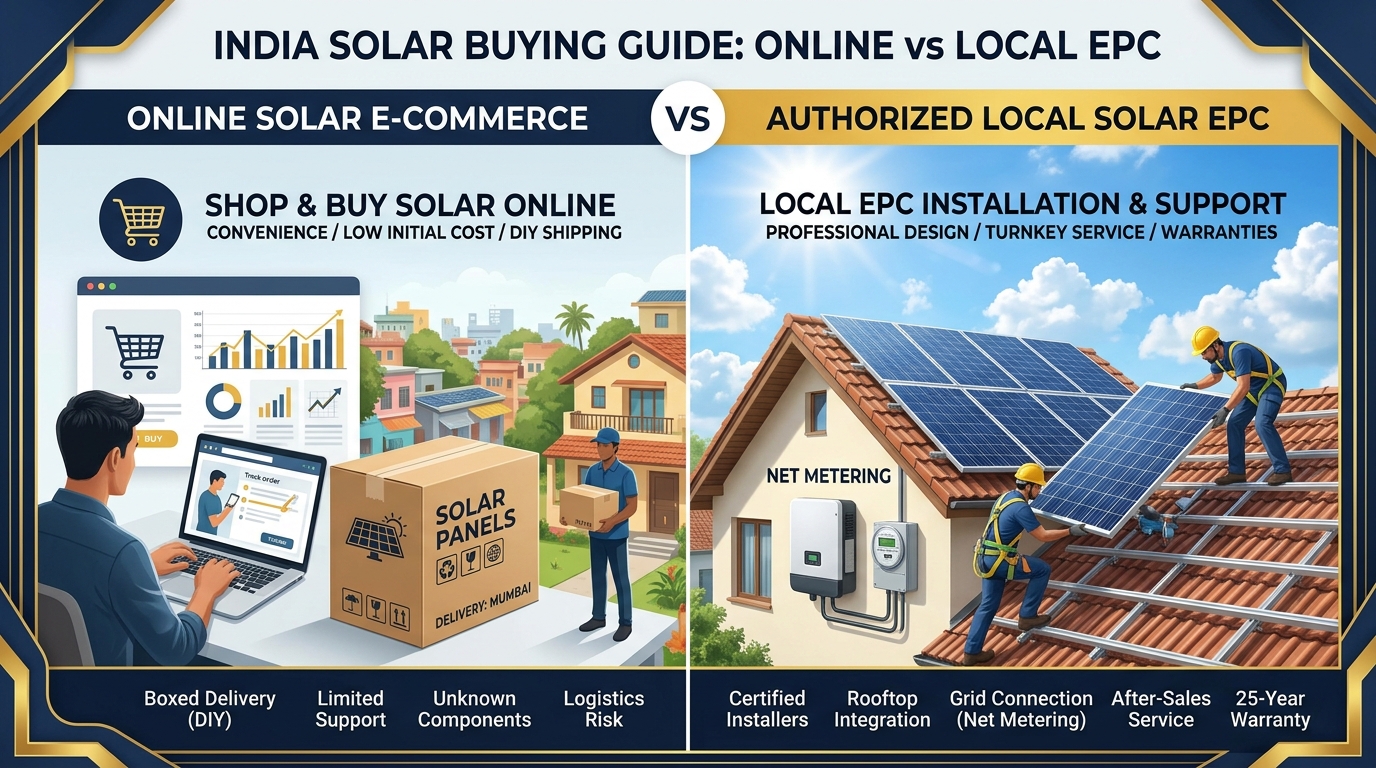
The popularity of solar power has skyrocketed across India as homeowners, commercial businesses, and factories look to eliminate escalating utility electricity bills. When deciding to make the switch, property owners face a fundamental procurement question: Should you buy solar panels online through e-commerce portals and manufacturer websites, or purchase a turnkey solution from an authorized local solar dealer?
While ordering solar panels online offers the allure of digital convenience, instant price comparisons, and attractive hardware discounts, working with a local solar EPC (Engineering, Procurement, and Construction) dealer provides indispensable on-site engineering, residential rooftop solar installation expertise, DISCOM net metering approvals, and reliable 25-year after-sales support.
In this in-depth guide, Brightleaf Energy provides an unbiased breakdown comparing online solar shopping versus local solar dealership models to help you make the most cost-effective and technically sound decision for your property.
Understanding Solar Panel Buying Options
Buying a solar power system is vastly different from purchasing standard consumer electronics. A solar setup is a miniature power plant generating high-voltage direct current (DC) and alternating current (AC) on your roof for 25+ years. Your procurement method determines whether you receive unbundled raw equipment or a synchronized, code-compliant turnkey energy system.
What Does Buying Online Mean?
Purchasing solar panels online entails buying hardware modules directly via manufacturer web portals, B2B wholesale marketplaces, or major e-commerce platforms.
- •You receive hardware delivered in crates to your doorstep.
- •Installation, wiring, inverter mounting & DISCOM liaison are self-arranged.
- •Best suited for seasoned electrical contractors or DIY hobbyists.
What Is a Local Solar Dealer?
A local solar dealer (like Brightleaf Energy) is a licensed, MNRE-registered EPC contractor providing end-to-end solar development for homes and enterprises.
- Free 3D shadow analysis and structural roof engineering.
- Procurement of Tier-1 ALMM-listed PV modules & inverters.
- Turnkey net metering clearance with state DISCOMs & subsidy paperwork.
- Local technician warranty dispatch and preventative AMC services.
How the Solar Buying Process Differs
When you buy online, the transaction ends when the delivery truck leaves your driveway. When buying through a local dealer, the relationship begins at the site survey and continues throughout the 25-year generation lifespan of your system.
Online requires you to guess your sanction load and roof tilt. A local dealer measures your exact azimuth, shading obstacles, and seasonal irradiance.
Online leaves DISCOM net metering and PM Surya Ghar subsidy portal filing to the buyer. Local dealers handle the entire bureaucratic process.
Online equipment must be integrated by a licensed electrician. Local dealers provide complete testing, earthing pits, lightning arrestors, and bidirectional meter testing.
Benefits of Buying Solar Panels Online
For knowledgeable buyers with technical proficiency or pre-existing installation contractors, online marketplaces offer several clear advantages:
Online platforms operate with reduced physical retail overheads, enabling them to offer competitive seasonal promotions, bulk module pallet rates, and flash sales.
Easily browse across Mono PERC, N-Type TOPCon, HJT, and Bifacial panels across 450W to 600W+ ratings, along with diverse string and microinverter brands.
Compare temperature coefficients, efficiency percentages (21% vs 23%), and datasheet specs from multiple manufacturers without salesperson pressure.
Valuable for remote rural areas or off-grid farmhouses where specialized local solar dealerships or component retail outlets are unavailable.
Drawbacks & Hidden Risks of Buying Solar Online
While buying hardware online looks simple in your cart, rooftop solar installation involves critical structural, legal, and electrical safety hurdles:
You cannot check for cell micro-cracks or busbar soldering defects before signing delivery waivers.
Finding a certified installer willing to mount unverified customer-supplied equipment is challenging and often expensive.
Solar glass panels are fragile. If crates suffer hidden impacts during transit, resolving courier damage claims can take months.
Non-ALMM or unverified online components cannot qualify for the ₹78,000 PM Surya Ghar residential subsidy.
Benefits of Buying Solar Panels from a Local Dealer
Partnering with an authorized local solar EPC installer such as Brightleaf Energy ensures your solar power system operates at peak efficiency from Day 1 with guaranteed return on investment:
Local technicians visit your property, evaluate parapet wall shadows, inspect water tank elevations, test structural dead-weight capacity, and engineer high-grade galvanized iron (GI) or aluminum mounting structures angled for maximum annual sun harvest.
Connecting to the local utility grid (e.g. BSES/Tata Power in Delhi, DHBVN in Gurugram & Faridabad, or PVVNL in Noida & Ghaziabad) requires DISCOM portal registration, CEIG safety inspection, test reports, and bidirectional meter installation. A local EPC handles this entire workflow seamlessly.
If an inverter displays an error code during peak summer heat, a local dealer dispatches a service engineer within 24–48 hours. If a module fails performance testing, the dealer executes the OEM warranty exchange on your behalf without shipping costs.
By preventing electrical mismatches, DC cable losses, and poor mounting orientation, a professionally installed solar system generates 15–25% more kilowatt-hours (units) over its lifetime compared to an improvised DIY installation.
Cost Comparison: Online vs Local Solar Dealers
When evaluating solar expenses, never look at module hardware prices in isolation. Evaluate the complete 25-year Levelized Cost of Energy (LCOE):
| Cost Factor | Buy Solar Panels Online | Local Solar EPC Dealer |
|---|---|---|
| Solar Panel Equipment Cost | Lower headline price via direct e-commerce discounts & bulk hardware sales. | Bundled pricing with engineered mounting, balance of system (BOS) & accessories. |
| Installation & Commissioning | Not included; homeowner must independently source & pay a certified solar installer. | 100% turnkey inclusion with professional electrical engineers & safety rigging. |
| Freight & Heavy Shipping | Extra shipping charges apply; buyer carries risk of transit glass breakage. | Transit insurance and safe site delivery included in the turnkey contract. |
| Site Survey & Roof Engineering | Self-managed or available at third-party cost; high risk of improper shading assessment. | Free comprehensive 3D shadow analysis, structural integrity check & load audit. |
| DISCOM Net Metering & Subsidy | Self-service; customer handles portal paperwork, DISCOM testing & inspector visits. | End-to-end liaison with power utilities (Tata Power, BSES, DHBVN, UPPCL) & subsidy credit. |
| Warranty & Replacement Service | Direct RMA with OEM manufacturer; buyer pays return shipping & de-installation. | Single point of contact; local technician diagnoses on-site and executes OEM warranty. |
| Post-Installation Maintenance (AMC) | No dedicated after-sales support; third-party call-out charges for troubleshooting. | Annual maintenance contracts, regular cleaning guidance & generational yield monitoring. |
How to Choose a Reliable Solar Panel Seller
Whether you select an online marketplace or a regional EPC contractor, follow this 6-point verification checklist before making any advance payments:
Verify at least 50+ authentic local customer reviews and inspect real photo galleries of completed rooftop installations in your city.
Ensure panels are listed on MNRE’s latest ALMM (Approved List of Models and Manufacturers) and inverters carry BIS IS 16221 / IS 16169 compliance.
Confirm a 25-year panel performance warranty (≥80% output at year 25), 10-12 year product warranty, and a written 5-year workmanship warranty.
Avoid vague lump-sum quotes. Require clear brand names and ratings for panels, inverters, DC/AC distribution boxes, lightning arrestors, and cables.
Common Mistakes to Avoid When Buying Solar Panels
Frequently Asked Questions (FAQ)
Quick answers to common questions regarding purchasing solar panels online vs through authorized dealers.
1Is it cheaper to buy solar panels online in India?
Yes, upfront equipment prices online can be 10–20% lower due to direct sales and low overheads. However, when you add separate certified installation, heavy freight shipping, mounting structures, and net metering liaison, the total turnkey project cost often ends up similar to or higher than a local dealer package.
2Are online solar panels genuine and certified?
They can be genuine if purchased directly from authorized manufacturer stores or verified distributors. However, unverified e-commerce listings risk supplying uncertified B-grade modules, non-ALMM panels ineligible for PM Surya Ghar subsidies, or refurbished inverters.
3Can I install solar panels myself (DIY) in India?
DIY installation is strongly discouraged for grid-connected rooftop solar. Indian DISCOMs mandate that grid-tied systems and net meters be installed, tested, and certified by registered Class-A electrical contractors and MNRE-empaneled solar EPCs.
4Can local solar dealers match online equipment prices?
Local dealers often match overall package value. While hardware-only quotes may look slightly higher, local dealers bundle site surveys, custom engineering, structural fabrication, DISCOM approvals, and multi-year AMC services that online platforms do not include.
5Which buying option provides better warranty support?
Local solar dealers offer significantly easier warranty handling. If an inverter trips or a panel suffers micro-cracks, your local dealer inspects on-site and coordinates manufacturer replacements on your behalf, avoiding tedious online shipping claims.
6What is the safest way to buy rooftop solar panels?
The safest route is contracting an established local solar EPC company like Brightleaf Energy that provides Tier-1 ALMM-listed panels, BIS-certified inverters, turnkey DISCOM net metering clearance, and written workmanship guarantees.
7Are local solar dealers worth the extra upfront investment?
For 95% of residential and commercial property owners, yes. The long-term peace of mind, guaranteed annual generation yield, rapid on-site emergency repairs, and subsidy disbursement assistance vastly outweigh the minor initial convenience of online cart shopping.
8How do I avoid solar panel scams and sub-standard hardware?
Always verify the installer's MNRE registration, ask for ALMM (Approved List of Models and Manufacturers) compliance, insist on itemized quotations with OEM serial numbers, and inspect customer reviews on Google across regional installations.
9What certifications should I look for before purchasing solar panels?
Mandatory certifications in India include BIS (IS 14286 / IS 61730), IEC 61215 for design qualification, IEC 61730 for module safety, and ALMM listing for residential government subsidy eligibility.
10Which option is best for commercial and industrial solar projects?
Commercial installations strictly require full-service local solar EPC contractors due to high-voltage HT meter synchronization, structural load engineering, fire safety compliance, CEIG factory approvals, and accelerated depreciation tax documentation.
Conclusion & Final Verdict
Both buying options serve specific use cases. Buying solar panels online can offer price savings and broad product availability for experienced electricians or small off-grid hobby setups.
However, for complete home rooftop solar and commercial solar solutions, partnering with an established, authorized local solar EPC dealer like Brightleaf Energy delivers far superior value. From complimentary site assessments and DISCOM net metering permits to subsidy sanction and reliable on-ground maintenance, a local dealer protects your 25-year financial investment.
Sources & Official References
- PM Surya Ghar: Muft Bijli Yojana — official national portal
- Ministry of New and Renewable Energy (MNRE), Government of India
- MNRE ALMM — Approved List of Models and Manufacturers
Subsidy amounts, tariffs, and scheme details are subject to change and site/DISCOM approval. Verify against the official portals above before relying on any figure.
Related Solar Guides & Articles
Complete price guide with PM Surya Ghar subsidy math, bill savings & payback.
Payback formulas, commercial ROI breakdown & 25-year wealth generation.
Crucial checklist for vetting solar contractors, MNRE registration & warranties.
On-Grid vs Off-Grid vs Hybrid inverters, pricing specs & efficiency ratings.